

Solar Power for Rice Mills and Agricultural Processing Plants in Thailand 2026: Rooftop PV ROI for Paddy Drying, Cold Storage, Pumps, and Export ESG
Thailand’s agricultural processing sector is entering a new energy-cost cycle. Rice mills, cassava starch plants, fruit packing houses, seed processing facilities, animal feed mills, rubber sheet processors, seafood support facilities, and cold-storage operators all face rising electricity costs, export buyer ESG questions, and pressure to improve operating margins. Rooftop solar is one of the most practical tools available because many agricultural processors have large roofs, strong daytime demand, and long-term ownership of their sites.
This article focuses on rice mills and agricultural processing plants in Thailand in 2026. It explains where solar creates savings, how to size systems around seasonal operations, what ROI can look like in provinces such as Nakhon Sawan, Suphan Buri, Ayutthaya, Chachoengsao, Khon Kaen, Ubon Ratchathani, and Chiang Rai, and what owners should check before signing an EPC or PPA contract.
Why Agriculture Processing Is Different from General Manufacturing
Agricultural processors are not all the same. Some operate year-round; others have intense seasonal peaks. Rice mills may run at high load after harvest and lower load during off-season. Fruit packing houses may peak during export windows. Cold storage and seed facilities may require stable loads for temperature control. Solar design must reflect this pattern. A system sized only from the highest harvest-month bill may be too large for the rest of the year, while a system sized too conservatively may miss important savings during peak processing months.
- Large roofs: Warehouses, paddy storage buildings, processing halls, and packing sheds often provide usable PV area.
- Daytime motors: Conveyors, mills, compressors, pumps, sorters, dryers, and packing lines often run during solar hours.
- PEA service territory: Many sites are outside Bangkok, so PEA connection requirements, local transformer capacity, and feeder conditions matter.
- Export ESG: Buyers of rice, fruit, seafood, rubber, and processed food increasingly ask for carbon and energy data.
- Seasonal risk: ROI depends on correctly modelling harvest, storage, and export cycles rather than using a single monthly bill.
Where Electricity Is Used in a Thai Rice Mill
Rice milling is mechanically intensive. Electricity is used for intake conveyors, bucket elevators, pre-cleaners, huskers, whiteners, polishers, graders, color sorters, air compressors, dust collection, packing lines, lighting, office loads, pumps, and sometimes paddy drying. The exact profile depends on mill size, moisture content, automation level, and whether the facility also operates storage silos or parboiling equipment.
| Process | Typical equipment | Solar relevance |
|---|---|---|
| Paddy intake and conveying | Conveyors, elevators, motors | Good daytime match during operating shifts |
| Milling and polishing | Huskers, whiteners, polishers | High motor load; strong savings when lines run daily |
| Sorting and grading | Color sorters, graders, compressors | Electricity-intensive and often daytime |
| Drying | Fans, heaters, controls, sometimes biomass integration | Solar offsets electrical fans and auxiliary loads |
| Storage and packing | Ventilation, lighting, packing machines | Stable base load for self-consumption |
ROI Case Study: 900 kWp Rice Mill in Central Thailand
Consider a rice mill in the central plains with large warehouse roofs, two main harvest seasons, and year-round storage and packing activity. The site has a PEA connection, a daytime milling schedule, and a monthly electricity bill that rises sharply after harvest. The owner wants to reduce electricity cost without changing production operations.
| Item | Assumption |
|---|---|
| Installed capacity | 900 kWp rooftop solar |
| Annual generation | 1.15-1.35 million kWh |
| Self-consumption | 65-85% depending on seasonal production and weekend load |
| CAPEX range | THB 27-38 million for a conventional rooftop EPC project |
| Electricity value | THB 3.8-5.0/kWh depending on tariff and demand profile |
| Annual savings | THB 3.0-5.5 million before O&M and financing |
| Simple payback | 5.5-8.5 years, with better results for year-round processors |
The biggest variable is not panel efficiency; it is utilization. If milling runs mostly during harvest months and there is little off-season load, the owner may need a smaller system, a phased installation, or additional flexible loads such as daytime drying fans, cold storage, or EV forklifts. If the mill also operates packing, storage ventilation, and export preparation throughout the year, the solar economics improve significantly.
Solar for Cold Storage and Fruit Packing
Fruit, vegetable, seed, and seafood-related agricultural processors often have a stronger solar match than seasonal mills because refrigeration loads run every day. Cold rooms, blast chillers, ice machines, compressors, evaporator fans, pumps, and packing lines create a reliable daytime and nighttime base load. Solar can offset daytime compressor energy, while controls can pre-cool during solar hours when product quality requirements allow it.
For facilities in Chanthaburi, Rayong, Chiang Mai, Chiang Rai, Surat Thani, Songkhla, and Samut Sakhon, the design should account for humidity, corrosion, roof insulation, food-safety requirements, and maintenance access. Cold-storage solar projects should also consider whether battery storage is valuable for power quality or backup support, not just energy arbitrage. In many cases, a smaller battery for controls, doors, and critical systems may be more practical than a large battery intended to run compressors overnight.
PEA Connection and Export Control
Most agricultural processing plants are under PEA rather than MEA. The owner should not assume that a rural feeder can accept unlimited export or that the existing transformer is suitable for a large PV system. A proper feasibility study includes transformer rating, main breaker capacity, single-line diagrams, protection settings, reverse power relay requirements, voltage-rise checks, and export-control design if required.
For a practical overview, see Red Solar’s guide to PEA and MEA grid connection for rooftop solar in Thailand. Owners comparing tariff impact should also review Thailand TOU tariff and solar ROI.
Seasonal Load Modelling: The Core of Agricultural Solar ROI
Agricultural solar projects fail financially when the model uses an average bill without understanding seasonality. The project team should request monthly bills for at least two years, production volume by month, harvest calendars, operating shifts, weekend operations, diesel generator use, and planned expansion. If interval data is not available, temporary metering can be installed for representative weeks during both peak and low seasons.
| Question | Why it matters |
|---|---|
| How many months per year does the mill run at high load? | Determines realistic self-consumption and system size |
| Are drying fans and pumps operated during daylight? | Flexible loads can absorb midday solar output |
| Does the site have cold storage or ventilation loads year-round? | Improves off-season utilization |
| Will production expand or add export packing? | Can justify a larger system or phased design |
| Is export limited by PEA? | May require zero-export control and smaller capacity |
Business Models: EPC, Financing, and PPA
Agricultural processors often prefer practical financing structures. Some owners want full asset ownership; others prefer a PPA or energy service model that avoids upfront capital. The right answer depends on credit profile, land and building ownership, roof condition, family business succession plans, and whether the plant is preparing for export certification or buyer audits.
| Model | Best fit | Advantage | Caution |
|---|---|---|---|
| Owner-funded EPC | Profitable mills with available capital | Highest long-term savings | Requires upfront investment and O&M responsibility |
| Bank-financed EPC | Processors with stable cash flow | Ownership with lower immediate cash burden | Lender may require technical reports and insurance |
| PPA / EMC | Owners avoiding CAPEX | Predictable solar price and lower technical burden | Long-term roof access and contract obligations |
| Phased EPC | Seasonal sites with uncertain load growth | Reduces oversizing risk | Needs expansion-ready electrical design |
Export ESG and Buyer Requirements
Thai agricultural exporters increasingly sell into markets where carbon reporting, supply-chain emissions, and sustainability documentation matter. Rice, fruit, rubber, animal feed, and processed food buyers may not require every supplier to install solar today, but many ask for energy data, emissions reduction plans, or renewable-energy initiatives. A well-monitored solar system gives the processor credible numbers: annual generation, self-consumed renewable electricity, avoided emissions, and cost savings that can be shared in buyer audits.
Owners should avoid vague claims such as “100% green factory” unless the data supports it. A better approach is to report the actual percentage of annual electricity offset by solar and to show a roadmap for efficiency measures such as motor upgrades, compressor leak reduction, dryer controls, LED lighting, and energy management. Solar works best when it is part of a disciplined energy program.
Roof and Site Risks in Agricultural Facilities
Older agricultural buildings may have mixed roof types, corrosion, dust, bird issues, weak purlins, or limited maintenance access. Some roofs were designed for storage, not for additional PV loads and technician walkways. Before installation, the owner should complete a structural review, check asbestos or fragile materials, plan cleaning access, and confirm that panel layout will not interfere with ventilation, ridge vents, skylights, or fire access.
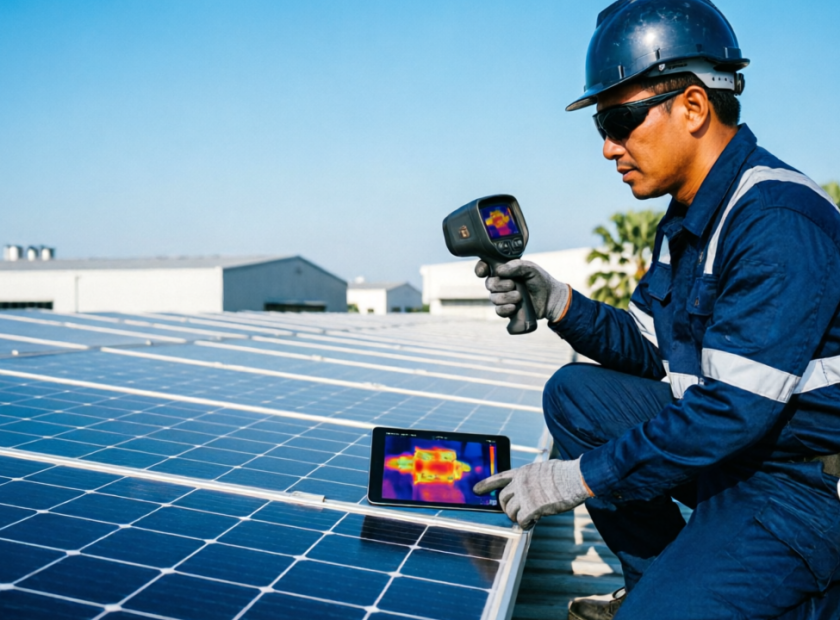
Dust can be significant near rice husk handling, feed mills, unpaved yards, and rural roads. The O&M plan should include safe cleaning intervals, inverter inspections, thermal scans, vegetation control, and production monitoring. A cheap system that is not maintained will underperform; a slightly more expensive system with proper monitoring can produce better lifetime returns.
Battery Storage: Useful, but Not Always First Priority
Battery storage is sometimes attractive for agricultural processors with unreliable grids, short outages, or critical cold rooms. However, batteries should be justified carefully. For pure electricity bill reduction, rooftop solar without battery usually delivers faster payback. Batteries may make sense for power quality, critical controls, backup for cold-chain protection, demand management, or sites with high diesel generator costs. The correct design depends on outage history, load criticality, and the value of spoiled product risk reduction.
For more detail, see Red Solar’s guide to battery energy storage systems in Thailand.
Implementation Checklist for Rice Mills and Agricultural Processors
- Collect at least 24 months of PEA bills, demand data, and production volume by month.
- Separate milling, drying, cold storage, pumps, packing, lighting, and office loads.
- Build a seasonal load model rather than relying on one peak harvest bill.
- Inspect roof structure, corrosion, dust conditions, drainage, and maintenance access.
- Check transformer capacity, protection requirements, export limits, and PEA documentation.
- Compare EPC, financed EPC, PPA, and phased installation options.
- Plan O&M around dust, birds, harvest-season operations, and safe roof access.
- Create buyer-ready ESG reporting with measured generation and emissions reduction data.
Beyond Rice: Cassava, Animal Feed, Rubber, and Seed Processing
Rice mills are only one part of Thailand’s agricultural processing opportunity. Cassava starch plants in Nakhon Ratchasima, Chaiyaphum, Kamphaeng Phet, and Sa Kaeo often have high motor loads, pumps, conveyors, centrifuges, and drying-related equipment. Animal feed mills use grinders, mixers, pelletizers, conveyors, boilers, compressors, and bagging lines. Rubber processing facilities use rollers, dryers, pumps, smokehouses, and wastewater systems. Seed processing and grain storage facilities use ventilation, sorting, grading, drying, and temperature-control systems. Each sector has a different load shape, but many have large daytime electrical demand that can absorb solar output.
The key is not to copy a generic factory solar design. Cassava processing can be water and pump intensive. Feed mills may have strong production runs tied to livestock cycles. Rubber and fruit processing may be affected by season, rainfall, and export windows. Seed and grain storage may have lower process loads but useful ventilation and conditioning loads. A good feasibility study maps the actual production calendar and then decides whether the system should be sized for year-round base load, peak-season load, or a phased expansion path.
| Processor type | Useful solar load | Design caution |
|---|---|---|
| Cassava starch plant | Pumps, motors, conveyors, centrifuges, drying auxiliaries | Wastewater areas and corrosion must be considered |
| Animal feed mill | Grinding, mixing, pelletizing, bagging, compressors | Dust management and fire safety are critical |
| Rubber processor | Rollers, dryers, pumps, ventilation, wastewater systems | Roof corrosion and humidity can affect mounting choices |
| Fruit packing house | Cold rooms, sorting, washing, packing, ice machines | Refrigeration reliability and food safety access matter |
| Seed or grain storage | Ventilation, drying fans, elevators, lighting | Seasonality can reduce annual self-consumption |
Energy Efficiency Should Come Before Final Solar Sizing
Solar reduces the cost of electricity, but energy efficiency reduces the amount of electricity the plant needs in the first place. Agricultural processors often have large motors, compressed-air systems, fans, pumps, and older electrical panels. Before locking the PV capacity, the owner should review motor efficiency, variable frequency drives, compressor leaks, pump sizing, power factor, dryer controls, and operating schedules. If a plant is planning to replace motors or add automation, the solar model should use the future load profile, not only historical bills.
Motors and VFDs
Many rice mills and processing plants operate motors at fixed speed even when full output is not needed. Variable frequency drives can reduce energy use on fans, pumps, and conveyors, while also allowing the site to shift some flexible load into solar hours. Coordinating VFD upgrades with solar can improve both energy savings and process control.
Compressed Air and Dust Collection
Compressed air is expensive electricity in another form. Leaks, excessive pressure, and poor maintenance can waste energy every day. Dust collection and ventilation systems are also important in mills and feed plants. Improving these systems can reduce base load and improve worker safety, but the solar model must be updated after efficiency measures are planned.
Practical Financing for Family-Owned Agricultural Businesses
Many Thai agricultural processors are family-owned businesses that evaluate investment differently from listed companies or multinational factories. They may own land and buildings, prefer conservative debt levels, and value supplier relationships. Solar proposals should therefore show simple payback, cash-flow impact, maintenance responsibility, roof obligations, and what happens if production changes. A transparent proposal is usually more persuasive than an overly complicated financial model.
For family businesses, a phased system can be attractive. The first phase may cover the reliable year-round load, while the electrical design reserves space for a second phase if production expands or a new cold room is built. This approach avoids oversizing while preserving future flexibility. If the owner chooses a PPA, the contract should clearly explain minimum purchase obligations, roof access, early termination, insurance, system removal, and what happens if the plant is sold to the next generation or another operator.
Permitting, Safety, and Rural Site Execution
Rural and semi-rural sites have practical execution issues that are easy to underestimate. Access roads may be narrow during rainy season. Roofs may be dusty, slippery, or fragile. Existing electrical rooms may need upgrades before PV can be connected safely. Some sites use backup diesel generators, which require anti-islanding and control coordination so solar, grid, and generator systems do not conflict. The EPC contractor should inspect these details before final pricing.
Safety planning is especially important during harvest season, when trucks, workers, dust, and time pressure increase. Installation may be better scheduled during lower production months, even if the owner wants the system finished quickly. A project that delays harvest operations or blocks truck movement can cost more than the energy it saves in the first year.
How to Use Solar Data in Export and Certification Conversations
Export-oriented processors can use solar monitoring data in customer presentations, sustainability questionnaires, and certification audits. Useful metrics include annual solar generation, percentage of site electricity covered by PV, estimated CO2e avoided, operating availability, and the link between solar and broader energy-efficiency measures. This data can support conversations with buyers in Japan, Europe, the United States, China, and regional ASEAN markets.
The most credible reporting is measured and modest. Instead of claiming that the whole product is carbon neutral, the processor can state that a defined percentage of electricity consumption is supplied by on-site solar and that the company is implementing additional efficiency measures. This builds trust and gives buyers numbers they can use in supply-chain reporting.
Conclusion
Solar power can be a strong investment for rice mills and agricultural processing plants in Thailand, but the project must be designed around seasonal reality. The best results come from facilities with large roofs, strong daytime motor loads, year-round cold storage or packing activity, and owners who value long-term operating-cost control. By combining careful load modelling, PEA connection planning, roof due diligence, and honest ESG reporting, agricultural processors can reduce electricity costs while strengthening their export story. Red Solar can help rice mills, cold-storage operators, and agricultural exporters evaluate EPC, financing, PPA, and phased solar options. To start a feasibility review, visit the Red Solar contact page.