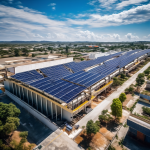


Your solar panels will sit on your factory roof for 25 years. Maybe 30. Through monsoon seasons, 40°C heat, salt air if you’re near Laem Chabang, and whatever else Thailand’s tropical climate throws at them.
The warranty you sign today determines whether that investment pays off — or becomes a very expensive rooftop decoration.
Most factory owners in Thailand focus on price per watt, panel efficiency, and installer reputation. Those all matter. But the warranty? That’s where the real risk hides. And it’s the one thing most people don’t read until something goes wrong.
Here’s everything you need to know about solar panel warranties in Thailand before you sign on the dotted line.
Why Warranty Matters More in Thailand Than You Think
Thailand isn’t Germany. It isn’t California. It’s a hot, humid, tropical country with a monsoon season that lasts six months, and industrial estates where rooftop temperatures regularly hit 65°C or higher.
Solar panels here face conditions that most warranty documents were written for temperate climates. The fine print assumes a panel will degrade at a certain rate under normal conditions. But “normal” in Rayong looks very different from “normal” in Munich.
The result? Panels that degrade faster than the warranty expects. Claims that get denied because the damage falls under an exclusion you never noticed. And manufacturers headquartered in another country who take three months to respond to a warranty request.
I’ve seen factory owners discover — in Year 4 or 5 — that their warranty covers almost nothing relevant to their actual situation. By then, the panels are already installed, the system is running, and renegotiating isn’t an option.
Don’t let that be you.
The Two Types of Solar Panel Warranties (And Why Both Matter)
Every solar panel comes with two separate warranties. They cover completely different things, they last different lengths of time, and most people confuse them. Understanding the difference is the first step to protecting your investment.
Product Warranty (Materials and Workmanship)
The product warranty covers physical defects in the panel itself. Think of it like a manufacturer’s guarantee on any other product — if something breaks due to a manufacturing defect, they replace it.
What it typically covers:
- Frame defects and corrosion
- Junction box failures
- Glass cracking from manufacturing defects
- Delamination (layers of the panel separating)
- Connector and cable defects
Typical length: 10 to 15 years for most Tier 1 manufacturers. Some premium brands offer 25 years.
What’s usually excluded — and this is critical:
- Damage from improper installation (the installer’s fault, not the manufacturer’s)
- Damage from extreme weather events beyond specified thresholds (hail larger than 25mm, wind speeds above 2,400 Pa)
- Damage from cleaning with abrasive materials or high-pressure water
- Normal wear and tear
- Discoloration that doesn’t affect performance
Here’s where Thailand-specific issues come in. The humid, salty air around industrial estates near the Eastern Seaboard — Laem Chabang, Map Ta Phut, Amata City — can cause frame corrosion that manufacturers argue is “environmental damage” rather than a “manufacturing defect.” If your warranty doesn’t explicitly cover salt air corrosion, you might be on your own.
Similarly, humidity-induced delamination is more common in tropical climates. Some warranties exclude it. Others cover it. You need to check.
Performance Warranty (Power Output Guarantee)
The performance warranty is a promise about how much electricity the panel will still produce after a certain number of years. This is the warranty that matters most for your financial calculations.
How it works:
- Year 1: Panel output guaranteed at 97-98% of rated capacity (a small initial drop is normal)
- Years 2-25: Guaranteed annual degradation of 0.40% to 0.55% per year
- Year 25: Good panels should still produce 85-87% of their original rated output
The math matters: If you install a 500kW system and the panels degrade faster than the warranty guarantees, you’re not just losing a few percentage points of output. You’re losing actual baht. Over 25 years, the difference between 0.40% and 0.55% annual degradation on a 500kW system can amount to hundreds of thousands of baht in lost electricity production.
Linear vs. step warranties: There are two formats you’ll see:
- Linear warranty: Guarantees a specific output percentage for every single year (e.g., Year 10 = 93%, Year 15 = 90.5%). This is the better format.
- Step warranty: Guarantees output only at certain milestones (e.g., 90% at Year 10, 80% at Year 25). Between the steps, you have no specific guarantee.
Always prefer linear warranties. They give you clear, enforceable numbers for every year of the system’s life.
What Thailand’s Climate Does to Solar Panels
Understanding the warranty is one thing. Understanding how Thailand’s actual environment affects panel degradation is another. They’re connected — because the warranty’s degradation guarantee needs to match reality.
Heat Is the Silent Killer
Solar panels are rated at 25°C (Standard Test Conditions). That’s a laboratory temperature. Nobody’s rooftop in Thailand runs at 25°C.
On a typical day in a Rayong industrial estate, a rooftop solar panel will reach 65-75°C. That’s 40-50 degrees above the rating temperature. Every degree above 25°C reduces the panel’s output by approximately 0.35% to 0.40%, depending on the panel’s temperature coefficient.
But heat does more than reduce daily output. It accelerates long-term degradation. Studies of solar panels in tropical climates show annual degradation rates of 0.50% to 0.65%, compared to 0.30% to 0.40% in temperate European climates.
This matters for your warranty because most manufacturers guarantee 0.40-0.55% annual degradation — numbers based on global averages that include temperate markets. If your panels are degrading at 0.60% per year because they’re on a rooftop in Samut Prakan, you may or may not have a valid warranty claim depending on how the guarantee is worded.
What to look for in the spec sheet:
- Temperature coefficient of Pmax (should be -0.35%/°C or better)
- Maximum operating temperature rating (should handle at least 85°C)
- NOCT (Nominal Operating Cell Temperature) — lower is better for hot climates
Panels with a temperature coefficient of -0.30%/°C will lose significantly less output in Thailand’s heat compared to panels rated at -0.45%/°C. Over a 500kW system, that difference is worth real money every single year.
Humidity and Monsoon Damage
Thailand’s rainy season runs from roughly May to October. That’s six months of near-daily moisture exposure, high humidity, and the occasional severe storm.
Three specific risks emerge from this environment:
PID (Potential Induced Degradation): This is a phenomenon where voltage differences between the solar cells and the frame cause power loss. PID is significantly more common in humid, hot environments — exactly Thailand’s conditions. Panels that aren’t PID-resistant can lose 5-15% of their output within the first few years. Some warranties exclude PID entirely. Others cover it. Check before buying.
Frame corrosion: Panels installed near the coast — and many of Thailand’s major industrial estates are within 20km of the Gulf of Thailand — face salt air exposure. Aluminum frames corrode. Anodized frames resist corrosion better. But not all warranties cover corrosion damage, especially if the manufacturer argues the installation location is “coastal” and therefore outside their expected use case.
Junction box failures: The junction box is where the panel’s electrical connections live. In a humid environment, moisture can penetrate poorly sealed junction boxes, causing short circuits and power loss. Look for IP68-rated junction boxes — they’re sealed against dust and can withstand prolonged water immersion. If the spec sheet doesn’t mention IP rating, ask.
Red Flags in Solar Panel Warranties
After reviewing dozens of warranty documents from manufacturers selling into Thailand, here are the clauses that should make you pause — and in some cases, walk away.
Void If Installed by Non-Certified Installer
This is the single most common warranty trap. The warranty document states that the product warranty is only valid if installation is performed by a manufacturer-certified installer.
Sounds reasonable until you realize:
- Your installer might go out of business (the Thai solar market has seen several EPC companies fold in recent years)
- The manufacturer’s certified installer list might not include anyone operating in your area
- If you switch installers for maintenance, does that void the warranty?
How to protect yourself: Negotiate for warranty language that doesn’t tie coverage to a specific installer. Or at minimum, ensure the warranty remains valid if installation is performed by a licensed electrical contractor following the manufacturer’s installation guidelines. The key phrase to look for is “installed in accordance with manufacturer specifications” — not “installed by certified installer.”
Prorated vs. Full Replacement
Some performance warranties are “full replacement” for the entire warranty period. Others become “prorated” after a certain year — typically Year 10 or 15.
A prorated warranty means that if a panel fails in Year 18, you don’t get a full replacement panel. You get a panel whose value is calculated based on how many years remain in the warranty. In practice, this means you receive a panel worth perhaps 30-40% of the original value — which might not even cover the cost of having it installed.
Always push for full replacement warranty. If the manufacturer won’t budge, understand exactly what the proration formula is and factor that risk into your financial model.
Labor and Removal Costs — The Hidden Gap
This is the gap that catches almost everyone.
Most solar panel warranties cover the cost of the replacement panel. They do NOT cover:
- The labor cost to remove the defective panel
- The labor cost to install the replacement
- Scaffolding or crane rental (essential for factory rooftops)
- Electrical testing and reconnection
- Disposal of the defective panel
In Thailand, the labor and equipment cost to replace a single panel on a factory roof can run 3,000-8,000 baht per panel — easily 30-50% of the panel’s value. If you have 10 panels fail over the warranty period, you’re looking at 30,000-80,000 baht in costs that the warranty doesn’t cover.
Some EPC companies include a workmanship warranty that covers installation-related labor for a period (typically 2-5 years). After that, you’re on your own. Factor this into your long-term maintenance budget.
Tier 1 vs. Tier 2 — Does the Ranking Matter for Warranty?
If you’ve researched solar panels, you’ve seen “Tier 1” mentioned everywhere. But here’s what most people don’t know: BloombergNEF’s Tier 1 classification is a financial ranking, not a quality assessment.
A panel is “Tier 1” if the manufacturer has supplied panels to multiple large-scale projects that received financing from banks that use BloombergNEF’s criteria. That’s it. It tells you the company is financially stable enough for bankable projects. It does NOT tell you:
- Whether the panels are good quality
- Whether the warranty terms are favorable
- Whether the company will still exist in 15 years to honor that warranty
Some Tier 2 manufacturers offer better warranties than Tier 1 brands. Some Tier 1 brands have warranty terms full of exclusions. The ranking alone tells you almost nothing about warranty protection.
What actually matters:
- How long has the manufacturer been in business? (10+ years is a good baseline)
- Do they have a local office or partner in Thailand? (This is huge for warranty claims)
- What is their warranty claim track record? (Ask your EPC company)
- Are they financially stable? (Check credit ratings, not just BloombergNEF tier)
In Thailand, the market is dominated by Chinese manufacturers — Trina, Jinko, Longi, JA Solar, Canadian Solar. All are reputable. But the warranty claim process, response time, and local support vary significantly between them.
This is where Red Solar’s model offers an advantage. With panels manufactured at our facility in Rayong, warranty claims don’t require shipping defective panels back to China or waiting months for a response. Local manufacturing means local accountability.
How to Read Your Solar Panel Warranty Document
You don’t need a law degree. You need to know what to look for.
Key Clauses to Find and Understand
Degradation rate: Look for two numbers — the Year 1 degradation (typically 2-3%) and the annual degradation rate (typically 0.40-0.55%). These numbers should be clearly stated as guaranteed minimums, not estimates.
Temperature coefficient: This should be listed in the technical datasheet, not the warranty document. It tells you how much output is lost per degree above 25°C. For Thailand, look for -0.35%/°C or better (closer to zero is better).
What voids the warranty: This section lists everything that will cancel your warranty coverage. Common exclusions include:
- Hail larger than specified diameter (usually 25mm)
- Wind loads exceeding specified limits
- Cleaning with abrasive materials
- Installation on certain roof types
- Modifications to the panel or wiring
Claim process: How do you actually file a claim? Who do you contact? What documentation is required? What’s the expected response time? If the warranty document doesn’t specify a response time, that’s a red flag.
Transferability: If you sell your factory, does the warranty transfer to the new owner? Most do, but some require notification and a small transfer fee. Others don’t transfer at all — which reduces your factory’s resale value.
Questions to Ask Before Signing
Take this list to your next meeting with your solar provider:
- What is the guaranteed annual degradation rate? (Should be 0.55% or less)
- Is the warranty transferable if I sell my factory? (Should be yes)
- Who pays for removal and reinstallation labor if a panel fails? (Should be covered or at least defined)
- What is the warranty claim process and expected response time? (Should be specified — ideally within 30 days)
- Does the warranty cover PID in tropical/humid climates? (Should be explicitly covered)
- What documentation do I need to maintain for warranty claims? (Usually: installation records, commissioning report, annual maintenance logs)
- Is the warranty backed by the manufacturer or the installer? (Manufacturer-backed is stronger)
- Does the warranty cover salt air corrosion for coastal installations? (Important for Eastern Seaboard factories)
If your provider can’t answer these questions clearly, or if they deflect, consider it a warning sign.
Real Warranty Claims in Thailand — What Actually Happens
Theory is one thing. Reality is another. Here are three warranty claim scenarios from actual Thai factory installations.
Case 1: Chonburi Electronics Factory — Microcracks in Year 3
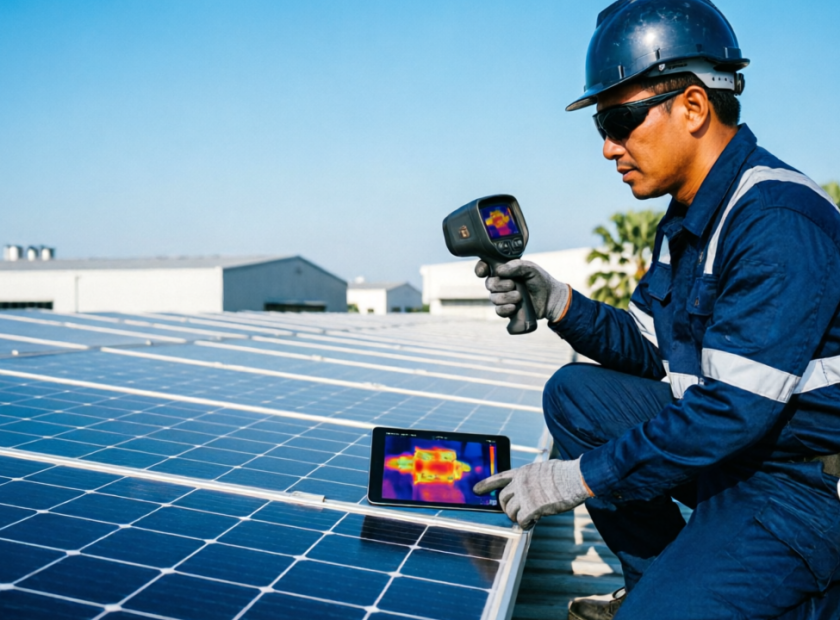
A 300kW system installed on a factory roof in Amata Nakorn Industrial Estate started showing reduced output in its third year. Thermal imaging revealed microcracks in approximately 12% of the panels.
The warranty claim process took 4 months. The manufacturer initially denied the claim, arguing that the microcracks were caused by “improper handling during installation” — which would void the warranty. The EPC company had to provide installation documentation, photos from the installation day, and an independent engineering assessment to prove the cracks were manufacturing defects (delamination-related), not handling damage.
Lesson: Keep thorough documentation from Day 1. Photos, installation records, commissioning reports. If you don’t have proof of proper installation, the manufacturer has an easy reason to deny your claim.
Case 2: Rayong Food Processing Plant — Frame Corrosion After 8 Years
A 200kW system installed near the coast in Rayong showed significant aluminum frame corrosion on panels facing the Gulf of Thailand. The warranty claim was denied because the warranty excluded “damage from corrosive environments.”
The factory owner hadn’t realized that “corrosive environment” was defined in the warranty as any location within 5km of a coastline. Their factory was 3km away.
Lesson: Read the warranty exclusions carefully. If you’re near the coast, specifically ask whether the warranty covers salt air corrosion. If it doesn’t, negotiate for an addendum or choose a different panel brand.
Case 3: Bang Pa-In Industrial Estate — PID Affecting 15% of Array in Year 5
A 500kW system in Ayutthaya province experienced widespread PID, affecting approximately 15% of the panels. Output had dropped by roughly 8% compared to initial commissioning levels.
Fortunately, the panel manufacturer’s warranty explicitly covered PID. The claim was approved within 6 weeks, and replacement panels were shipped within 3 months. However, the cost of removal and reinstallation — approximately 150,000 baht for 75 panels — was not covered by the warranty.
Lesson: Even a good warranty has gaps. Budget for the labor costs that warranties don’t cover. And always choose PID-resistant panels for installations in Thailand’s humid climate.
Red Solar’s Warranty Approach for Thailand
We manufacture panels at our facility in Rayong, Thailand. That’s not just a production detail — it fundamentally changes how warranty claims work.
What this means for you:
- Local warranty support: No shipping defective panels to China. No waiting months for a response from an overseas headquarters. Our warranty team is in Thailand, speaking your language, understanding your timeline.
- Factory-direct accountability: The same company that manufactures your panels is the same company that honors the warranty. There’s no gap between manufacturer and supplier.
- Thailand-specific warranty terms: Our warranty documents are written with Thailand’s climate in mind. PID coverage, humidity-related degradation, and salt air considerations are addressed explicitly — not buried in exclusions.
- Standard warranty package: We include product warranty, linear performance warranty, and clear claim procedures with defined response times. No prorated clauses. No “certified installer only” traps.
When you’re investing in a solar system that will generate electricity for 25+ years, the warranty isn’t a formality. It’s a core part of your financial model.
Bottom Line — What Every Thai Factory Owner Should Know
Before you sign any solar panel purchase or installation agreement, run through this checklist:
The 3 warranty terms that matter most:
- Annual degradation rate — Should be 0.55% per year or less, guaranteed in writing
- PID coverage — Must be explicitly included, not excluded
- Claim process clarity — Defined contact, defined response time, defined documentation requirements
When to walk away from a deal:
- The warranty is prorated after Year 10 with no clear formula
- The manufacturer has no presence or partner in Thailand
- PID is excluded from the warranty
- The warranty requires a specific installer with no transfer option
- The manufacturer can’t provide a clear answer on what voids the warranty
How warranty fits into your total ROI:
When you calculate the return on your solar investment, don’t just look at panel price and expected output. Factor in:
- The cost of a potential warranty claim that isn’t covered (labor, scaffolding, lost production during replacement)
- The risk of faster-than-expected degradation (a 0.10% difference in annual degradation rate on a 500kW system = significant baht over 25 years)
- The value of a transferable warranty if you plan to sell the factory
A good warranty doesn’t just protect you from things going wrong. It gives you confidence in the numbers that drove your investment decision in the first place.
Your solar panels will outlast most of the equipment in your factory. Make sure the warranty lasts that long too.
Want to discuss solar panel options and warranty terms for your factory? Contact Red Solar for a free consultation. We manufacture in Rayong and stand behind every panel we produce.