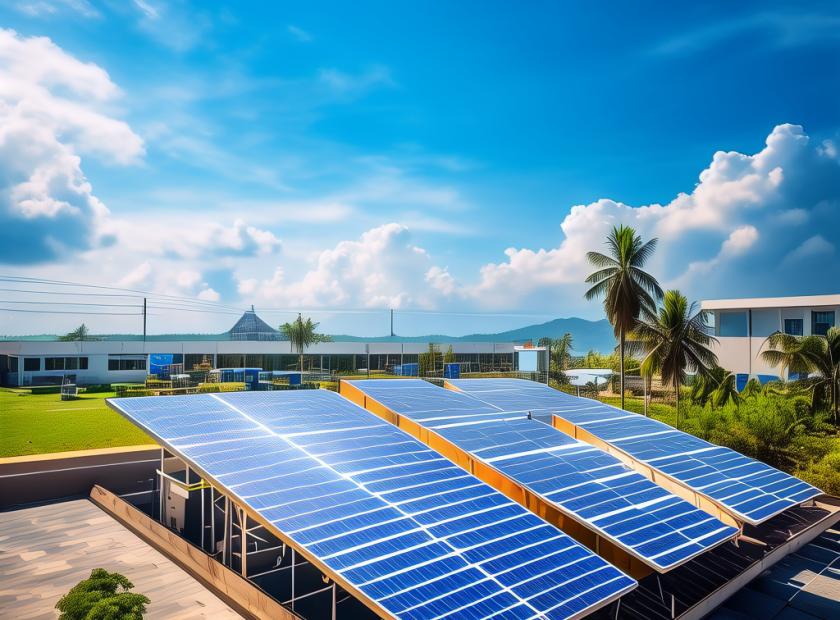


Why Pharmaceutical and Medical Device Factories in Thailand Are Strong Solar Candidates
Thailand is one of Southeast Asia’s most important manufacturing bases for pharmaceuticals, medical devices, diagnostics, rubber gloves, disposable medical products, nutraceuticals, and export-oriented healthcare equipment. Facilities in Bangkok, Samut Prakan, Pathum Thani, Ayutthaya, Chonburi, Rayong, Chachoengsao, and the Eastern Economic Corridor often operate under strict GMP, ISO 13485, ISO 14644, HACCP, or client audit requirements. These factories need stable electricity for cleanrooms, HVAC, compressed air, process water, cold rooms, sterilization support systems, packaging lines, laboratories, and quality-control equipment.
That energy profile makes rooftop solar unusually practical. Pharmaceutical and medical device facilities normally consume significant power during daylight hours, precisely when Thailand’s solar irradiation is strongest. Rooftop PV cannot replace validated backup power, UPS systems, emergency generators, or critical process controls, but it can reduce grid purchases for large daytime base loads and improve ESG reporting without disrupting validated manufacturing operations.
For factory owners, finance teams, and plant engineers, the question is not simply whether solar panels work. The real question is how to size, install, connect, and monitor a rooftop PV system without creating risk for GMP compliance, cleanroom pressure, product quality, roof waterproofing, fire safety, or production continuity. This guide explains the practical answer for Thailand in 2026.
Thailand Market Context: Pharma, Medical Devices, and Healthcare Manufacturing
Thailand’s healthcare manufacturing sector includes domestic pharmaceutical producers, contract manufacturers, multinational medical device suppliers, packaging and labeling facilities, hospital product suppliers, herbal and supplement factories, and exporters serving ASEAN, Japan, Europe, and the United States. The sector benefits from Thailand’s industrial estates, skilled workforce, ports, logistics routes, and BOI-supported investment environment.
Many facilities are not enormous heavy-industry plants, but their electricity intensity can be high because of environmental control. A 10,000-30,000 square meter pharmaceutical or medical device factory can have a power bill similar to a much larger warehouse because cleanrooms and HVAC systems run continuously. Air handling units, chilled water systems, dehumidification, process exhaust, compressed air, and cold storage can create a consistent load profile that is ideal for high solar self-consumption.
| Facility Type in Thailand | Typical Energy Drivers | Solar Fit | Key Design Caution |
|---|---|---|---|
| Pharmaceutical tablet/capsule plant | HVAC, dehumidification, compressed air, packaging, QC labs | High | GMP validation zones and dust control during installation |
| Medical device assembly | Cleanrooms, testing, assembly lines, lighting, compressed air | High | Cleanroom pressure stability and rooftop access control |
| Diagnostics or lab product factory | Temperature control, cold rooms, lab equipment, packaging | Medium-High | Power quality for sensitive laboratory instruments |
| Rubber glove or disposable product plant | Process equipment, HVAC, boilers auxiliaries, packaging | High | Large roof sections and production shutdown planning |
| Cold-chain medical storage | Refrigeration, cold rooms, freezers, monitoring systems | High | Critical load separation and backup strategy |
Electricity Consumption Pattern in GMP and Cleanroom Facilities
Pharmaceutical and medical device factories are different from ordinary assembly plants. Even when production lines are not running at full speed, air handling and environmental systems may continue to operate. This creates a reliable base load that improves solar economics. A typical factory may use 35-55% of electricity for HVAC and cleanroom air systems, 8-15% for compressed air and utilities, 10-20% for process and packaging equipment, 5-12% for cold rooms and refrigeration, and the remainder for lighting, offices, water systems, laboratories, and auxiliary loads.
Cleanrooms and HVAC
Cleanroom energy use is dominated by air changes, filtration, pressure control, cooling, and dehumidification. Thailand’s hot and humid climate increases the value of solar because cooling loads are strongest in the daytime. A rooftop PV system can directly offset the electricity used by chillers, AHUs, pumps, and fan systems during peak operating hours.
Cold Rooms and Temperature-Controlled Storage
Many pharma and medical device facilities require 2-8°C storage, controlled room temperature zones, or freezer areas. Solar works well with cold rooms because refrigeration load is steady and partly daytime-weighted. However, the solar system should not be described as backup power unless it is integrated with a properly engineered battery, generator, transfer, and control system.
Power Quality and Sensitive Equipment
QC laboratories, inspection machines, sterilization monitoring equipment, and medical device testing systems may be sensitive to voltage fluctuations. A professional solar EPC should review transformer capacity, main distribution boards, harmonics, protection coordination, inverter settings, and data monitoring before connection. Solar should reduce bills, not introduce uncertainty into validated processes.
ROI Case Study: 800kWp Rooftop Solar for a Chonburi Medical Device Factory
Consider a medical device assembly and packaging facility in Chonburi with ISO 13485 certification, controlled assembly areas, cold storage, and a monthly electricity bill of THB 2.8-3.6 million. The roof has approximately 6,000 square meters available after excluding skylights, drainage paths, maintenance access, fire zones, and unsuitable roof sections.
| Parameter | Assumption |
|---|---|
| Solar system size | 800kWp rooftop PV |
| Estimated annual generation | 1,040,000-1,200,000 kWh/year |
| Self-consumption rate | 80-92% |
| Industrial electricity tariff range | THB 4.0-5.0/kWh depending on tariff and load profile |
| Estimated CAPEX | THB 24-34 million depending on roof, equipment, and electrical scope |
| Annual gross savings | THB 3.3-5.3 million |
| Simple payback | About 5-8 years |
| CO₂ reduction | About 520-700 tons/year depending on emission factor |
This payback range is realistic for Thailand when the plant consumes most solar generation on site. It can improve if the factory has high daytime peak demand, a strong electricity tariff, BOI or tax benefits, low financing cost, or multiple buildings that allow a larger system. It can become weaker if the roof is small, old, shaded, leased with short remaining term, or if weekend/holiday load is low.
Business Models: EPC, PPA/EMC, and Rooftop Lease
Pharmaceutical and medical device companies often evaluate solar through more than one lens. Engineering teams care about reliability and compliance. Finance teams care about return and cash flow. Regional ESG teams care about emissions reporting and renewable energy claims. Procurement teams care about supplier risk. The right commercial model depends on which constraint is most important.
| Model | Best For | Advantages | Trade-Offs |
|---|---|---|---|
| EPC / Self-Investment | Factory owners with CAPEX budget and long-term site control | Highest long-term savings, asset ownership, direct ROI | Requires upfront investment and internal asset management |
| EMC / PPA | Factories wanting lower bills without upfront CAPEX | No or low initial investment, developer operates system | Savings per kWh lower than ownership; contract review required |
| Rooftop Lease | Landlords or sites with underused roof but limited internal load | Rental income, simple business case | Less direct electricity saving; depends on project structure |
| Portfolio Rollout | Healthcare manufacturers with multiple Thai sites | Standardized design, supplier leverage, ESG consistency | Needs phased audits and strong project governance |
GMP and Validation Considerations Before Installing Rooftop Solar
A solar project at a healthcare manufacturing facility must be planned differently from a warehouse installation. The PV array sits outside the production area, but construction activity, roof penetration, cable routing, shutdowns, electrical testing, and maintenance access can still affect GMP-controlled operations.
Dust, Noise, and Access Control
Installation teams should follow site access procedures, construction zoning, tool control, housekeeping, and work permits. Dust and debris from roof works must not enter air intakes or production areas. In many projects, high-risk work is scheduled during weekends, holidays, or planned shutdown windows.
Roof Waterproofing and Structural Review
Many Thai factories use metal sheet roofs, reinforced concrete roofs, or mixed roof structures. Solar design should include roof load review, purlin assessment, wind load design, drainage clearance, walkway planning, and waterproofing details. A cheap design that causes leaks above GMP storage or packaging areas is not cheap at all.
Electrical Shutdown Planning
Solar interconnection may require work at the main distribution board, transformer, or low-voltage panel. For GMP facilities, shutdown planning must be coordinated with production, QA, maintenance, cold-room monitoring, IT, security, and validation teams. Temporary risk controls may be needed for temperature-sensitive inventory.
How to Size Solar for a Pharma or Medical Device Factory
Solar sizing should start with 12 months of interval load data if available, not only monthly bills. The goal is to maximize self-consumption while avoiding excessive export, operational complexity, and grid approval issues. A good first estimate is based on roof area, daytime base load, transformer capacity, and weekend load.
| Monthly Electricity Bill | Indicative Solar Size | Typical Roof Area Needed | Suitable Facility Profile |
|---|---|---|---|
| THB 500,000-1,000,000 | 150-350kWp | 1,100-2,600 sqm | Small medical device or supplement factory |
| THB 1,000,000-2,500,000 | 350-700kWp | 2,600-5,200 sqm | Medium GMP production and packaging site |
| THB 2,500,000-5,000,000 | 700kWp-1.5MWp | 5,200-11,000 sqm | Large cleanroom, cold-chain, or multi-building plant |
| Above THB 5,000,000 | 1.5MWp+ | 11,000 sqm+ | Large portfolio site or integrated manufacturing campus |
These figures are only screening estimates. Final sizing should consider demand peaks, PEA/MEA connection rules, transformer rating, roof age, insurance requirements, fire access, shading, export restrictions, and future expansion plans.
Battery Storage: Useful, But Not Always the First Investment
Factories often ask whether solar should be combined with battery energy storage. For pharmaceutical and medical device plants, batteries can support peak shaving, resilience, power quality strategies, or selected critical loads. But they should not be treated as a universal replacement for generators or validated UPS systems.
In 2026, many Thai factories still achieve better first-stage economics with rooftop solar alone. Battery storage becomes more attractive when the facility has high demand charges, weak grid reliability, strict resilience targets, planned EV charging, or a corporate requirement for deeper renewable integration. The correct approach is to design the rooftop solar project so that future BESS integration remains possible.
Internal Links for Further Planning
If your factory is located in an IEAT industrial estate or multi-tenant manufacturing zone, also read our guide to solar for industrial estates in Thailand. If your facility has server rooms, validation data systems, or cold-chain IT loads, our article on solar power for data centers and server rooms in Thailand may also help. Medical device suppliers with electronics assembly lines can compare with our electronics factory solar ROI guide.
Implementation Checklist for Thai Healthcare Manufacturers
| Step | What to Review | Who Should Join |
|---|---|---|
| 1. Energy audit | 12-month bills, interval load, transformer capacity, tariff class | Engineering, finance, solar EPC |
| 2. Roof and site survey | Structure, roof age, shading, access, drainage, fire route | Facility, safety, structural engineer |
| 3. GMP risk review | Air intakes, controlled zones, shutdown windows, material movement | QA, production, EHS, maintenance |
| 4. Commercial model | EPC vs PPA/EMC vs lease, contract term, ownership, guarantees | Management, finance, legal |
| 5. Grid application | PEA/MEA requirements, protection settings, export limitation | EPC, utility liaison, electrical team |
| 6. Construction plan | Work permits, safety method statement, shutdown coordination | EHS, facility, contractor |
| 7. Monitoring and reporting | Generation dashboard, CO₂ reports, O&M schedule, alarms | ESG, finance, facility |
Common Mistakes to Avoid
Choosing the Lowest Price Without GMP Experience
The lowest solar quotation may exclude roof reinforcement, waterproofing, monitoring, safety walkways, proper cable containment, construction controls, or post-installation O&M. In a healthcare manufacturing plant, a project delay or roof leak can cost more than the price difference between bidders.
Oversizing the System
A large PV system looks impressive, but if weekend or holiday load is low and export is restricted, oversizing can reduce returns. The best system is usually the one that matches the site’s real consumption profile and grid connection conditions.
Ignoring Insurance and Fire Safety
Insurers may require documentation for electrical design, DC isolators, fire access, labeling, cable routing, roof loading, and maintenance procedures. These requirements should be addressed before procurement, not after installation.
Why Work With Red Solar Thailand
Red Solar Thailand supports industrial and commercial clients with rooftop solar project development, equipment supply, EPC coordination, and business model design. For pharmaceutical and medical device factories, we focus on practical project planning: load analysis, roof suitability, safe installation sequencing, grid connection, ROI modeling, and long-term monitoring.
Our role is to help factory owners reduce electricity costs while respecting operational realities. Healthcare manufacturing sites cannot accept vague promises or risky construction methods. They need a solar partner that understands Thailand’s climate, industrial estate conditions, PEA/MEA requirements, roof structures, and the sensitivity of GMP or cleanroom operations.
Conclusion: Solar Can Cut Costs Without Compromising Compliance
Pharmaceutical and medical device factories in Thailand have some of the best solar profiles in the industrial market: stable daytime load, large roof areas, high cooling demand, strong ESG pressure, and long-term manufacturing operations. A well-designed rooftop PV system can reduce annual electricity costs by millions of baht, support customer sustainability requirements, and improve resilience planning without interfering with validated production.
The key is disciplined design. Start with energy data, confirm roof and electrical capacity, involve QA and EHS early, choose the right commercial model, and build a system that can be monitored and maintained for decades. If your factory is evaluating rooftop solar in 2026, contact Red Solar Thailand for a practical feasibility review and ROI estimate.