

Why Solar Panel Maintenance Matters More in Thailand Than Anywhere Else
If you’ve invested in a rooftop solar system for your factory in Thailand, you already know the numbers look good on paper. A well-designed 500kW system can save you THB 2-3 million per year. But here’s the uncomfortable truth that most solar installers won’t tell you during the sales pitch: those savings assume your panels are performing at their rated capacity — and in Thailand, they rarely are without proper maintenance.
The combination of Thailand’s tropical climate, seasonal monsoon rains, industrial dust from estates like Amata City and WHA, and the annual haze season can reduce solar panel output by 15% to 30% if left unaddressed. That’s not a marginal number worth ignoring. For a 1MW system generating THB 8 million in annual savings, even a 10% performance drop means THB 800,000 left on the table every year. Over the 25-year lifespan of a typical solar installation, that compounds to over THB 20 million in lost revenue from neglect alone.
This guide covers everything a factory owner, facility manager, or solar investor in Thailand needs to know about keeping solar panels performing at their best — broken down by season, with specific action steps, realistic cost estimates, and lessons learned from over 200 rooftop installations across the country.
The Real Cost of Dirty Panels in Thailand’s Climate
Let’s start with the numbers, because that’s what matters for your business. Every factory owner we talk to understands ROI — so let’s frame maintenance in those terms.
Solar panels accumulate dirt from several sources simultaneously in Thailand:
- Dust and particulate matter — Especially problematic near industrial estates in Rayong, Chonburi, and Samut Prakan, where manufacturing, logistics, and construction generate constant airborne dust. Facilities located near cement plants, chemical factories, or major highways see the fastest soiling rates.
- Pollen and organic debris — Thailand’s tropical vegetation produces heavy pollen loads, particularly during the hot season (March-May). Frangipani, rain trees, and mango trees — all common in industrial landscaping — shed heavily.
- Bird droppings — A surprisingly significant factor. Birds roosting on panels create localized shading that can disproportionately reduce string output. In Thailand’s warm climate, bird activity on rooftops is year-round, not seasonal.
- Air pollution and haze — The annual burning season (February-April) deposits a fine, sticky residue on panel surfaces that’s significantly harder to remove than ordinary dust. This is particularly severe in northern Thailand but affects the EEC region as well when southerly winds carry the pollution down.
- Hard water stains — After the monsoon season passes, evaporated rainwater leaves mineral deposits (calcium, magnesium, silica) on the glass surface. These deposits reduce light transmission and, over several years, create a permanent haze that only professional cleaning can address.
A 2024 study by the Asian Institute of Technology (AIT) in Pathum Thani measured soiling losses on rooftop installations across the Eastern Economic Corridor (EEC) and found average losses of 12-18% during the dry season, with peak soiling losses reaching 25% on panels that hadn’t been cleaned for six months or more. The study specifically noted that industrial locations near petrochemical facilities in Map Ta Phut experienced the highest soiling rates — up to 3% loss per month without cleaning.
The Hidden Impact of Partial Shading and Hot Spots
One thing that surprises many factory owners is how a small amount of dirt creates outsized losses. Solar panels are wired in strings — if even one panel in a string is partially shaded by bird droppings or a leaf pile, it drags down the entire string’s output. This is called the “Christmas light effect,” named after old-style Christmas tree lights where one dead bulb killed the whole string.
On a 500kW system with 20 strings of panels, a single heavily soiled panel might reduce the output of its entire 25-panel string by 30-50%. That means one dirty panel can cost you the equivalent output of 8-12 clean panels. When you consider that a 500kW installation typically has around 926 panels, even 10 badly soiled panels could be costing you THB 50,000-100,000 per year in lost generation.
Modern installations with panel-level optimizers (like Huawei’s SUN2000 series with optimizers, or systems using TIGO or SolarEdge components) mitigate this effect significantly by allowing each panel to operate independently. However, most existing installations in Thailand — particularly those built before 2023 — don’t have optimizers, making regular cleaning even more important.
Beyond soiling, hot spots are another major performance killer. These occur when a portion of a solar cell overheats due to micro-cracks, manufacturing defects, or cell mismatch. Hot spots not only reduce output — they permanently damage the panel and can eventually cause fires. Regular thermal imaging is the only way to detect hot spots before they cause irreversible damage.
Thailand’s Three Seasons: How Each Affects Your Solar Panels
Thailand’s climate divides into three distinct seasons, each presenting different maintenance challenges. Understanding these patterns lets you plan a maintenance schedule that’s efficient and proactive — not reactive and expensive.
Hot Season (March – May): Dust, Heat, and Haze
The hot season is when Thailand’s solar panels work hardest — and paradoxically, when they lose the most performance to soiling.
Key challenges during hot season:
- Peak dust accumulation. With little rainfall for weeks at a time, dust settles and essentially bakes onto panel surfaces. The combination of Thailand’s industrial emissions and agricultural burning in the north creates a sticky, fine particulate that adheres strongly to glass and becomes increasingly difficult to remove the longer it sits.
- Haze reduces irradiance. Even perfectly clean panels produce less during heavy haze periods because less sunlight reaches the panels in the first place. This is an atmospheric effect that cleaning can’t fix — but dirty panels compound the problem, creating a double loss.
- High temperatures reduce efficiency. Solar panel efficiency drops by approximately 0.35-0.45% per degree Celsius above 25°C (the standard test condition). Thailand’s rooftop temperatures regularly reach 55-65°C during the hot season, meaning panels can operate at 85-90% of their STC (Standard Test Conditions) rating purely due to heat — before accounting for any soiling losses.
- Inverter overheating. The same heat that affects panels also stresses inverters. Inverter rooms without adequate ventilation can see internal temperatures exceeding 50°C, triggering thermal shutdowns that halt production entirely during peak sunlight hours.
Recommended action during hot season:
Clean panels every 3-4 weeks during the hot season if your facility is near industrial activity or agricultural areas. For cleaner urban or coastal locations, every 6 weeks is usually sufficient. The cost of cleaning (typically THB 5,000-15,000 per cleaning for a 500kW system) is easily recovered by the performance gains. Check inverter room temperatures daily and ensure ventilation fans are running properly.
One practical tip from our field experience: schedule cleanings for early morning (6-8 AM) when panel temperatures are lowest. Cleaning hot panels with cool water can cause thermal shock and micro-cracking — the same physics that makes pouring cold water on a hot windshield crack the glass.
Rainy Season (June – October): The Natural Clean (With Caveats)
The rainy season is when many factory owners assume they don’t need to worry about panel cleaning. Thailand’s monsoon rains do provide a significant natural cleaning effect — but it’s not the whole story, and assuming otherwise is a common and expensive mistake.
What the rains actually do — and don’t do:
- Heavy downpours remove loose dust and pollen effectively. A genuine tropical thunderstorm with 50mm+ of rainfall can clean panels to about 85-90% of professionally-cleaned performance — but only if the panels were lightly soiled to begin with.
- Light rains can actually make things worse — they create mud from dust deposits without providing enough volume to rinse it away. This is particularly common during the early rainy season (June) when rain patterns are still transitioning.
- Post-rain mineral deposits — When rainwater evaporates, it leaves behind dissolved minerals (calcium, magnesium, silica) as white spots on the glass. Over several rainy seasons, this buildup reduces light transmission measurably. Panels that have never been professionally cleaned often develop a permanent cloudy film after 3-4 rainy seasons.
- Organic growth — The humidity and moisture during rainy season promotes algae and moss growth along panel edges and mounting frames, particularly on north-facing tilt angles where water drains more slowly. This organic growth creates permanent shading and can damage panel seals over time.
- Storm damage risk — Thailand’s most intense storms during September-October can dislodge panels, bend mounting frames, and damage cable routing. Post-storm inspections are essential.
Recommended action during rainy season:
Inspect panels monthly during the rainy season. You may not need full cleaning after every heavy rain period, but a mid-season clean (around August) to remove mineral deposits and organic growth is strongly recommended. After any major storm (wind speeds exceeding 80 km/h), conduct an immediate structural inspection — check for loose panels, bent frames, and exposed cables. This simple check prevents small issues from becoming THB 500,000+ repair bills.
Cool Season (November – February): The Optimal Maintenance Window
Thailand’s cool season is the best time for thorough maintenance — not just cleaning, but the full inspection and repair work that keeps your system running for its full 25-year design life.
Why cool season is ideal for maintenance:
- Lower temperatures mean safer and more comfortable working conditions for rooftop crews — this isn’t just about comfort. Workers can take the time to do thorough inspections instead of rushing through to avoid heat stress.
- Dry weather allows for accurate thermal imaging and electrical testing. Moisture from rainy season can mask electrical faults and distort thermal readings.
- Post-monsoon inspection catches any damage from heavy rains and wind before the next cycle begins. Identifying and repairing storm damage during the cool season prevents water ingress during the next rainy season.
- Early-season cleaning sets the baseline for optimal production during the highest-irradiance months (March-May). Starting the hot season with clean panels maximizes your revenue during the period when your system should be generating the most electricity.
Recommended action during cool season:
Schedule your comprehensive annual maintenance during November-December. This should include the full inspection checklist detailed below, plus professional cleaning to start the high-production season with clean panels. If your O&M contract includes thermal imaging and IV curve testing, this is the best time of year to perform them.
Your Solar Panel Maintenance Checklist: What to Inspect and When
Here’s a practical, actionable checklist that any facility manager in Thailand can follow. We’ve broken it down into tasks you can do yourself and tasks that require a qualified solar technician. This checklist is based on our experience maintaining over 50MW of installed capacity across Thailand.
Monthly Visual Inspections (Can Be Done In-House)
| What to Check | What to Look For | Why It Matters |
|---|---|---|
| Panel surface condition | Dirt buildup, bird droppings, visible debris, water streaks, cracked glass | Directly affects energy production; early detection prevents hardening of deposits |
| Mounting structure | Loose bolts, corrosion on aluminum rails, water pooling at mounting points | Structural integrity is critical — loose mounts can lead to panel detachment during storms |
| Cable routing and connectors | Exposed cables, UV damage on cable jackets, animal chewing (squirrels, birds, rats) | Compromised cables cause ground faults, arc faults, and fire risk |
| Inverter display and environment | Error codes, abnormal readings, reduced output compared to expected, dust in filters | Early warning of system-level problems; dirty filters cause inverter overheating |
| Drainage channels and gutters | Blocked gutters, debris accumulation, standing water near mounting points | Poor drainage causes water pooling, mineral deposits, and structural stress |
| Monitoring system data | Daily production vs. expected output, string-level performance comparison | Data anomalies often appear days or weeks before physical symptoms |
Quarterly Professional Inspections (Recommended)
These inspections should be conducted by a qualified solar technician or your O&M service provider:
- Thermal imaging scan — An infrared camera identifies hot spots, cell defects, and bypass diode failures that are completely invisible to the naked eye. A single faulty cell can reduce a panel’s output by 30% or more, and a hot spot left undetected can eventually cause a panel fire. This is the single most valuable diagnostic tool in solar maintenance.
- IV curve testing — Measures the current-voltage characteristic of panels to detect degradation that isn’t visible. This is especially important for systems 3+ years old, as it can identify early-stage cell degradation, PID (potential-induced degradation), or manufacturing defects that only manifest after years of operation.
- Torque check on all mounting hardware — Thailand’s storm-season winds, combined with the thermal expansion and contraction of metal components, can gradually loosen mounting bolts. A systematic torque check with a calibrated torque wrench prevents catastrophic panel detachment.
- Electrical connection inspection — Check MC4 connectors for water ingress, corrosion, or UV degradation. Inspect all junction boxes and combiner boxes. Loose or corroded connections are a leading cause of solar system fires in Thailand.
- Inverter maintenance — Clean inverter air filters, check cooling fan operation, verify firmware is current, review error logs, and test residual current devices (RCDs).
Annual Comprehensive Service (Essential)
This is your system’s annual health check — the equivalent of bringing your car in for a major service:
- Full panel cleaning — Professional cleaning with deionized water and soft-brush systems. Avoid high-pressure washers, which can damage the anti-reflective coating on the panel surface and void the manufacturer’s warranty.
- String-level performance analysis — Compare each string’s output to expected values under current weather conditions and identify underperforming circuits. This analysis should be documented and compared year-over-year to track degradation rates.
- Earthing system test — Verify all earthing connections are intact and within specification (typically less than 1 ohm resistance). Critical for lightning protection during Thailand’s intense storm season. A compromised earthing system is a safety hazard, not just a performance issue.
- Structural integrity assessment — Check for any panel micro-cracks (visible as hairline fractures in cells), frame deformation from wind loading, or mounting point wear. Document all findings with photographs for warranty purposes.
- Monitoring system calibration — Verify that your monitoring data accurately reflects actual production. Miscalibrated pyranometers or current sensors lead to bad decisions — you might think your system is underperforming when the sensor is simply reading low, or vice versa.
- Insurance and warranty review — Confirm your panel warranties are current, document any damage that may require warranty claims, and review your insurance coverage to ensure it still reflects the system’s replacement value.
DIY vs. Professional Maintenance: What Makes Sense for Thai Factory Owners
A common question we get from factory owners across Thailand — from small operations in Samut Prakan to large manufacturers in the EEC — is: “Can my own maintenance team handle this, or do I need to hire specialists?”
The honest answer: some of it, yes — but not all of it, and knowing the difference matters.
What Your In-House Team Can Handle
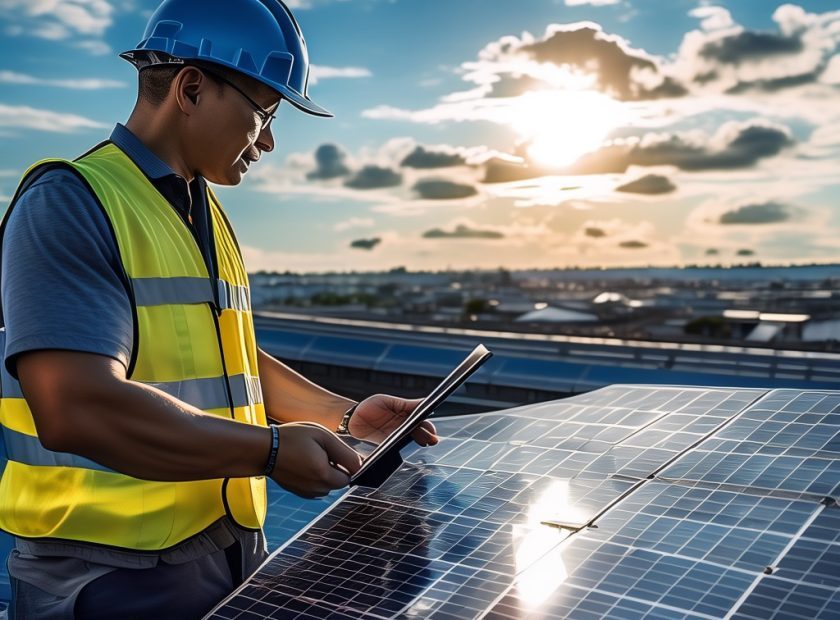
- Visual inspections — Walking the rooftop (safely!) to check for obvious issues takes 30-60 minutes and requires no special equipment beyond a checklist, a flashlight, and basic PPE. Your facility team already does rooftop inspections for HVAC and other equipment — adding solar panels to the route is straightforward.
- Basic panel cleaning — For smaller systems (under 200kW), a trained maintenance team can clean panels using deionized water, soft brushes, and proper safety equipment. The key requirements are: use deionized or RO water (not tap water, which leaves mineral deposits), soft non-abrasive brushes, and clean during early morning when panels are cool. Never use detergent unless specifically recommended by the panel manufacturer — most anti-reflective coatings are damaged by common cleaning chemicals.
- Monitoring data review — Checking your solar monitoring dashboard weekly and flagging anomalies takes 10 minutes and catches most issues before they become costly. Set up automated alerts for production drops exceeding 10% compared to the same day last week.
- Inverter area maintenance — Keeping the inverter room clean, checking for error codes on the display, and ensuring adequate ventilation are simple tasks any facility team can handle. Make sure inverter air filters are cleaned monthly during the hot season.
What Requires a Qualified Professional
- Thermal imaging and IV curve testing — Requires specialized equipment costing THB 200,000-500,000 and trained interpretation. A thermal image is only useful if you know what you’re looking at — and misinterpreting a thermal image can lead you to replace perfectly good panels while missing the actual problem.
- Electrical work — Any work involving live electrical connections, inverter servicing, or combiner box repairs should only be done by certified electricians. Thailand’s Department of Energy Development and Promotion (DEDP) requires solar system electrical work to be performed by licensed personnel.
- Structural assessments — Evaluating mounting integrity, identifying micro-cracks, and assessing wind-load damage requires experience, proper tools, and an understanding of structural engineering principles.
- High-altitude work — Rooftop work on taller buildings or steeply pitched roofs requires fall protection equipment, trained personnel, and compliance with Thailand’s occupational safety regulations (under the Occupational Safety, Health and Environment Act B.E. 2554).
For most factory installations in Thailand, we recommend a hybrid approach: your team handles monthly visual checks and basic monitoring, while a qualified solar service provider conducts quarterly inspections and the annual comprehensive service. This balance keeps costs manageable while ensuring critical tasks are done properly.
Maintenance Costs in Thailand: What to Budget
Let’s talk numbers — because maintenance is an investment, not an expense, and it’s important to get the math right for your financial planning.
Typical Maintenance Costs for a 500kW System
| Service | Frequency | Estimated Cost (THB) | Annual Total |
|---|---|---|---|
| Basic panel cleaning | Every 2 months (6x/year) | 5,000 – 8,000 per visit | 30,000 – 48,000 |
| Quarterly professional inspection | 4x/year | 8,000 – 12,000 per visit | 32,000 – 48,000 |
| Annual comprehensive service | 1x/year | 25,000 – 40,000 | 25,000 – 40,000 |
| Monitoring system subscription | Ongoing | 1,000 – 3,000/month | 12,000 – 36,000 |
| Total annual maintenance budget | 99,000 – 172,000 |
Now compare this to the potential loss from neglected maintenance: a 500kW system that loses even 10% of its output due to soiling and undetected faults is leaving THB 200,000-300,000 per year uncollected. The maintenance program pays for itself even at the high end of the cost range — and that’s before accounting for the avoided repair costs from catching problems early.
For larger systems (1MW+), the economics are even more favorable because cleaning and inspection costs don’t scale linearly with system size. A 1MW system might cost only 60-70% more to maintain than a 500kW system while generating twice the revenue. The per-watt maintenance cost actually decreases as system size increases.
The Cost of NOT Maintaining: A Real-World Example
We recently audited a 800kW system at a food processing factory in Chonburi that had been operating without any maintenance for two years. Here’s what we found:
- Soiling losses: Average 18% across the array (measured by comparing pre- and post-cleaning output)
- Hot spot damage: 23 panels with significant hot spots, 4 requiring full replacement
- Connector degradation: 6 MC4 connectors with water ingress, causing intermittent ground faults
- Mounting corrosion: Several aluminum mounting rails showing corrosion from unchecked water pooling
The total cost of neglect over two years: approximately THB 2.8 million in lost generation plus THB 180,000 in emergency repairs. A comprehensive maintenance program over the same period would have cost approximately THB 300,000. The return on maintenance investment, in this case, was nearly 10:1.
How Red Solar’s O&M Service Keeps Your Investment Protected
As we covered in our earlier article about the 4 solar business models available in Thailand, choosing the right model is just the beginning. Maintaining your system’s performance over its 25-year lifespan is where the real value is created — or lost.
Whether you invested through our EMC contract model or purchased your system outright through self-investment, the maintenance requirements are the same — and so are the consequences of neglect.
For clients who prefer not to manage maintenance in-house, Red Solar offers comprehensive Operations & Maintenance (O&M) packages tailored specifically to Thailand’s climate conditions and industrial environment:
- Basic O&M — Panel cleaning, visual inspections, monitoring alerts, and quarterly performance reports. Starting from THB 8,000/month for a 500kW system. Ideal for factory owners with capable in-house teams who need professional cleaning and periodic expert oversight.
- Standard O&M — Everything in Basic plus quarterly thermal imaging, IV curve testing, inverter maintenance, and priority response for faults. Starting from THB 15,000/month. Our most popular package — the right balance of cost and coverage for most commercial installations.
- Premium O&M — Full-service management including annual comprehensive service, warranty claim handling, insurance coordination, performance guarantees, and 24/7 monitoring with automatic alert response. Starting from THB 25,000/month. Designed for larger installations and facilities where energy reliability is critical.
All O&M packages include our performance guarantee: if your system’s output drops below the guaranteed threshold (accounting for normal panel degradation of approximately 0.5% per year), we cover the difference. This guarantee is possible because our factory-direct equipment and professional installation give us confidence in the system’s baseline performance.
Whether you manage your own maintenance or partner with us, the key is to have a plan. Thailand’s climate is unforgiving to neglected solar installations — but with the right maintenance schedule, your panels will deliver the savings you were promised for decades to come.
Quick Reference: Thailand Solar Maintenance Calendar
| Month | Season | Priority Actions |
|---|---|---|
| January-February | Cool (dry) | Annual comprehensive service, post-monsoon inspection, deep professional cleaning, earthing system test |
| March-May | Hot | Bi-monthly cleaning, monitor for heat-related performance drop, check inverter cooling, early-morning cleaning schedule |
| June-August | Rainy | Monthly visual inspection, check for algae/moss growth, mid-season clean if light rain dominates, post-storm checks |
| September-October | Rainy (peak) | Storm damage inspection, drainage verification, cable inspection after heavy rains, mounting bolt check |
| November-December | Cool (transition) | Pre-peak-season cleaning, monitoring system calibration, warranty and insurance review, schedule next year’s maintenance |
Ready to protect your solar investment? Contact Red Solar Thailand for a free maintenance assessment. We’ll evaluate your system’s current condition — whether we installed it or not — and recommend a maintenance plan that fits your budget and production targets.
📞 Call us: +66 (0) 62-106-6696
📧 Email: highlightingenergy.ad01@gmail.com
💬 Line: @redsolarth
Or visit our contact page to request a free consultation and site assessment.