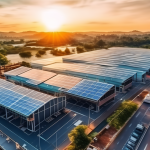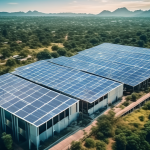


You’ve decided to go solar. Good. Now comes the actual hard part: where do you put the panels?
It sounds like a simple question. It’s not. The answer determines your system’s cost, energy yield, maintenance burden, regulatory pathway, and ultimately — whether the project pencils out over 25 years.
For factory owners in Thailand, the rooftop-versus-ground debate is especially consequential. Your rooftop might look perfect from a drone survey, but structurally it can’t carry the load. Or you have acres of land sitting idle that could generate power at lower cost — but the permitting process is completely different.
We’ve helped clients navigate this decision across Rayong, Chonburi, Chachoengsao, and beyond. Here’s everything you need to know to make the right call for your facility.
The Basic Economics: Cost Per Watt Comparison
Let’s start with the number that matters most upfront: installed cost per watt.
| Factor | Rooftop Solar (Thailand) | Ground-Mounted Solar (Thailand) |
|---|---|---|
| Installed cost | THB 28-38/W | THB 22-32/W |
| Typical system size | 100kW – 2MW | 500kW – 10MW+ |
| Balance of system | Lower (uses existing structure) | Higher (racking, foundations, trenching) |
| Installation complexity | Medium (roof access, safety) | Medium-High (civil works, grading) |
| Permitting complexity | Simpler (building modification) | More complex (land use, environmental) |
The short version: Ground-mounted systems are typically 15-25% cheaper per watt at the same scale. The cost advantage comes from easier installation access, no structural reinforcement needs, and the ability to use standard fixed-tilt racking optimized for your latitude.
But that’s only half the story. The real question isn’t “which costs less per watt.” It’s “which delivers more value per baht invested over 25 years.”
Rooftop Solar: The Default Choice (And When It Isn’t)
Rooftop solar is the natural starting point for most Thai factory owners. You already own the building. The roof is there. Why not put panels on it?
The Strong Case for Rooftop
Zero land cost. This is the biggest advantage. If your factory sits inside Amata City, WHA, or any of the major industrial estates in the EEC, land is expensive. Using rooftop space that would otherwise sit idle is essentially free real estate for power generation.
Proximity to consumption. Rooftop panels sit directly above or adjacent to your electrical loads. This means shorter cable runs, lower transmission losses, and simpler integration with your existing electrical distribution panel. For a typical Thai factory, rooftop-to-load-center distances are 20-50 meters versus 100-300 meters for ground-mounted arrays on the facility perimeter.
Simplified permitting. Under Thailand’s current building code framework, rooftop solar installations on existing industrial buildings typically require notification to the local municipality (OrBorTor) rather than full building permits. The process usually takes 2-4 weeks versus 2-3 months for ground-mounted systems that may trigger land-use review.
Cooling benefit. Solar panels on your rooftop reduce the building’s heat gain by 3-5°C underneath. In Thailand’s tropical climate, that’s a meaningful reduction in air conditioning load — estimated at 5-8% less cooling energy for the space below the panels. This isn’t just theory; we’ve measured it at our own Rayong facility where the production floor temperature dropped noticeably after panel installation.
When Rooftop Falls Short
Structural limitations. Many older factory buildings in Thailand — particularly those built before 2010 — were not designed to carry additional dead loads. A typical solar array adds 12-18 kg/m² to the roof. If your building was designed for a live load of 50 kg/m² with no margin, you may need structural reinforcement that adds THB 200,000-500,000 to the project cost, or you may need to abandon the rooftop option entirely.
Roof condition and remaining life. If your roof is 15 years old and needs replacement in 5-7 years, installing solar panels creates a complication: you’ll need to remove and reinstall the panels when the roof is replaced. This reinstallation cost — typically THB 50-80 per watt — can significantly erode your ROI. The cleanest approach is to replace the roof first, then install solar.
Shading and orientation. Thai factory roofs are often designed with a north-south ridge line, which means one side faces east and the other faces west. East-facing panels produce more in the morning; west-facing panels produce more in the afternoon. Neither orientation is optimal compared to south-facing. And if your rooftop has skylights, HVAC equipment, or adjacent buildings that cast shadows, your effective usable area can drop by 30-40%.
Space constraints. A 1MW rooftop system requires approximately 7,000-8,000 m² of unobstructed roof area. If your factory footprint is smaller than this, or if significant portions are occupied by skylights, vents, or structural obstacles, you simply won’t have enough space for the system size your business needs.
Ground-Mounted Solar: The Alternative (And When It Shines)
Ground-mounted solar is less common for Thai factories but offers distinct advantages in specific scenarios.
The Strong Case for Ground-Mounted
Lower cost per watt. As noted above, ground-mounted systems are typically 15-25% cheaper per watt to install. The savings come from standardized mounting structures, easier installation logistics (no need for crane lifts to the roof), and optimized tilt angles that maximize energy yield for your specific latitude.
Optimal tilt angle. In Thailand (latitude 5-18°N), the optimal fixed tilt angle for solar panels is approximately equal to your latitude — so 10-15° for most of the country. Ground-mounted systems can be built at exactly this angle. Rooftop systems are constrained by the existing roof pitch, which in Thailand is typically 5-10° for large industrial buildings. A ground-mounted system at 13° tilt in Rayong will produce approximately 3-5% more energy than the same panels mounted flat on a 5° roof.
Scalability. If you have the land, you can scale a ground-mounted system to virtually any size. Many industrial estates in Thailand have factories with 10-50 rai of land, and even using 2-3 rai for a ground-mounted array can accommodate a 2-5MW system.
Easier maintenance and inspection. Walking across a ground-mounted array is infinitely easier than climbing onto a rooftop in 38°C heat during the hot season (March-May). Cleaning, inspection, and repair work on ground-mounted systems is faster, safer, and cheaper.
Cooling advantage for panels. Ground-mounted panels typically operate 3-5°C cooler than rooftop panels because of better airflow underneath. Since solar panel efficiency decreases by approximately 0.4% per degree Celsius above 25°C, this translates to roughly 1-2% higher output in Thailand’s hot climate.
When Ground-Mounted Gets Complicated
Land opportunity cost. Every rai of land used for solar panels is land not used for production, warehousing, or future expansion. For a factory inside an industrial estate, land costs can run THB 3-8 million per rai. If you’re sacrificing production space, the economics change dramatically.
Permitting and environmental review. Ground-mounted solar arrays in Thailand may trigger additional regulatory requirements that rooftop systems avoid:
- Environmental Impact Assessment (EIA): Projects over 10MW may require a full EIA. Even below this threshold, some industrial estates have their own environmental review processes.
- Land-use classification: If your land is zoned for industrial use, installing a power generation facility may require a use-classification change or additional notification to the industrial estate authority.
- Grid interconnection: Ground-mounted systems typically connect at a different point in the facility’s electrical infrastructure than rooftop systems, which can affect the PEA/MEA interconnection application process.
Drainage and flood risk. Thailand’s monsoon season (May-October) brings heavy rainfall. Ground-mounted solar installations must account for site drainage to prevent water pooling around panel supports and trenching for underground cables. In flood-prone areas — including parts of Chachoengsao and Pathum Thani — foundation design needs to account for potential flooding.
Real Thai Factory Case Studies
Case 1: Amata City Rayong — Rooftop-Only Solution
Factory: Automotive parts manufacturer, 12,000 m² production floor
Roof area available: 8,500 m² usable after accounting for skylights and HVAC
System installed: 950kWp rooftop, fixed-tilt on 8° roof pitch
Installed cost: THB 32 million (THB 33.7/W)
Annual production: 1.38 million kWh
Annual savings: THB 6.2 million (at THB 4.50/kWh blended rate)
Payback period: 5.2 years
This factory had no available land — the building footprint occupied 90% of the plot, with only narrow access roads around the perimeter. Rooftop was the only option. The structural survey confirmed the roof could support the additional load without reinforcement, keeping costs in the typical range.
Case 2: WHA Rayong 36 — Hybrid Rooftop + Ground-Mounted
Factory: Food processing plant with cold storage, 6,000 m² production floor
Roof area available: 4,200 m² usable
Available land: 3 rai of unused perimeter land
System installed: 500kWp rooftop + 800kWp ground-mounted (1.3MW total)
Installed cost: THB 41.5 million (THB 31.9/W blended)
Annual production: 1.92 million kWh
Annual savings: THB 8.6 million
Payback period: 4.8 years
This case illustrates why a hybrid approach often makes the most sense. The rooftop system covered the base load during daylight hours, while the ground-mounted array was sized to handle the additional peak demand from the cold storage compressors. The ground-mounted portion was installed at 13° tilt, producing approximately 4% more energy per watt than the rooftop portion.
Case 3: Eastern Seaboard Industrial Estate — Ground-Mounted Only
Factory: Chemical manufacturing facility with rooftop constraints (hazardous materials storage, no roof penetration allowed)
Roof area available: None (safety restrictions)
Available land: 8 rai adjacent to production building
System installed: 2.5MWp ground-mounted, fixed-tilt at 12°
Installed cost: THB 67.5 million (THB 27/W)
Annual production: 3.65 million kWh
Annual savings: THB 16.4 million
Payback period: 4.1 years
This facility had no rooftop option due to safety regulations — chemical manufacturing buildings with hazardous material storage cannot have roof penetrations. The ground-mounted system was the only viable option, and the available land allowed for a much larger system than the facility’s initial 500kW requirement. The larger scale drove down the per-watt cost significantly.
The Decision Framework: How to Choose
Here’s a practical decision tree based on our experience with Thai factory installations:
Start with a Structural Roof Survey
This is non-negotiable. Before you do anything else, hire a qualified structural engineer to assess your roof’s load-bearing capacity. The survey should cost THB 30,000-80,000 and take 2-3 days. It will tell you:
- Can the roof support 12-18 kg/m² additional load?
- What is the roof’s remaining service life?
- Are there areas that need reinforcement (and at what cost)?
If the roof can’t support the load without significant reinforcement, or if the roof needs replacement within 5 years, your decision is already made: ground-mounted is the better option.
Map Your Available Space
Rooftop: Use a drone survey or satellite imagery to measure unobstructed roof area. Subtract space for skylights, HVAC equipment, fire vents, and a 1-meter maintenance perimeter around edges.
Ground: Walk your property. Identify areas that are not needed for production, parking, or future expansion. Account for setbacks from property lines, drainage areas, and underground utilities.
Calculate the maximum system size for each option (approximately 1kWp per 8-10 m² for rooftop, 1kWp per 12-15 m² for ground-mounted with spacing).
Compare the Numbers
| Metric | Rooftop | Ground-Mounted |
|---|---|---|
| System size (kWp) | [Your number] | [Your number] |
| Installed cost (THB/W) | 28-38 | 22-32 |
| Annual production (kWh) | [Calculated] | [Calculated] |
| Annual savings (THB) | [Calculated] | [Calculated] |
| Payback period (years) | [Calculated] | [Calculated] |
| 25-year NPV (THB) | [Calculated] | [Calculated] |
The system with the shorter payback and higher 25-year NPV wins. In our experience, approximately 70% of Thai factories can achieve better economics with rooftop-only or rooftop-primary systems, but the remaining 30% — particularly those with large land holdings and older roofs — benefit significantly from ground-mounted or hybrid approaches.
Don’t Overlook the Hybrid Option
The hybrid approach — rooftop for base capacity, ground-mounted for overflow — is increasingly popular among Thai factories, especially in the EEC. It gives you the best of both worlds:
- Use your rooftop for the first 300-500kWp at minimal additional land cost
- Add ground-mounted capacity if your rooftop is maxed out and you have available land
- Phase the investment: install rooftop first, add ground-mounted in year 2-3 as cash flow allows
This approach was used in the WHA Rayong case study above and delivered the shortest payback period (4.8 years) of the three cases, even though it involved both installation types.
Regulatory Considerations Specific to Thailand
Building Code and Structural Certification
Rooftop solar installations on industrial buildings in Thailand must comply with the Building Control Act B.E. 2522 (1979) and its amendments. Key requirements:
- Structural certification: A licensed civil engineer must certify that the building can support the additional load.
- Municipal notification: Installations over 10kW typically require notification to the local municipality.
- Fire safety: The installation must not block fire exits or emergency access routes.
Ground-mounted systems may be classified differently depending on the local authority’s interpretation. Some treat them as “temporary structures” (easier permitting), while others classify them as permanent installations requiring full building permits.
PEA/MEA Grid Interconnection
Both rooftop and ground-mounted systems connect through the same PEA (Provincial Electricity Authority) or MEA (Metropolitan Electricity Authority) grid interconnection process. The key differences:
- Rooftop systems typically connect through the building’s existing main distribution board, requiring a dedicated solar breaker and bi-directional meter.
- Ground-mounted systems may require a separate substation or connection point, particularly for systems over 1MW, which adds cost and permitting time.
For systems over 1MW, additional requirements apply regardless of installation type, including a detailed impact study and approval from the Electricity Generating Authority of Thailand (EGAT).
BOI Incentives
The Thailand Board of Investment (BOI) offers tax incentives for solar energy projects, including exemption from corporate income tax for up to 8 years and exemption from import duties on solar equipment. These incentives apply to both rooftop and ground-mounted systems, but the application process and documentation requirements differ slightly:
- Rooftop systems require building ownership documentation and structural certification.
- Ground-mounted systems require land ownership or lease documentation and may require environmental clearance for larger installations.
If you’re not already leveraging BOI incentives for your solar investment, read our complete guide to Thailand’s BOI solar incentives for a step-by-step walkthrough.
Five Mistakes Thai Factory Owners Make (And How to Avoid Them)
1. Choosing Based on Installed Cost Alone
The cheapest installation isn’t the best investment. A rooftop system at THB 35/W that produces 1.45 million kWh per year is better value than a ground-mounted system at THB 28/W producing 1.25 million kWh. Always compare cost per kWh produced over 25 years, not cost per watt installed.
2. Ignoring Roof Replacement Timeline
Installing solar on a roof that needs replacement in 3-5 years is a false economy. Factor the reinstallation cost (THB 50-80/W) into your ROI calculation, or replace the roof first.
3. Not Considering Future Expansion
Your factory will grow. Leave space on the rooftop or on the ground for additional capacity in 5-10 years. We’ve seen too many factories install a “perfect” system that maxes out available space, leaving no room for expansion when they add a new production line.
4. Underestimating Ongoing Maintenance Differences
Rooftop systems in Thailand require more frequent cleaning (dust, bird droppings, monsoon debris) and more expensive access (lift equipment or scaffolding). Ground-mounted systems are easier to clean and inspect but require vegetation management around the array perimeter. Budget accordingly.
5. Skipping the Energy Audit
Before deciding on system size or installation type, conduct a thorough energy audit of your facility. Understanding your consumption patterns — when you use power, how much you use, and what drives peak demand — is essential for sizing your system correctly. A system that’s too small wastes the opportunity; a system that’s too large exports power at rates far below your consumption rate, dramatically extending payback.
If you haven’t analyzed your electricity bill yet, our guide to reading PEA/MEA bills for solar planning walks you through the key numbers.
The Bottom Line
There’s no universal answer to “rooftop or ground-mounted” for Thai factories. The right decision depends on your building’s structural condition, your available land, your energy consumption profile, and your expansion plans.
But here’s what we know from 200+ projects across Thailand: the factories that get the best results are the ones that make this decision based on data, not assumptions. A structural survey, a drone-based space mapping exercise, and a detailed energy yield simulation will cost you perhaps THB 150,000-250,000 upfront — and can save you THB 5-15 million over the lifetime of the system.
That’s not a cost. That’s the best THB 250,000 you’ll ever spend on a solar project.
Ready to evaluate your factory? Contact Red Solar Thailand for a free site assessment and preliminary system design. Our engineering team will survey your rooftop, map your available land, and present you with rooftop-only, ground-mounted, and hybrid options — with full financial analysis for each — so you can make an informed decision.