

Why Cold Storage in Thailand Is Different from Every Other Solar Customer
If you run a cold storage warehouse in Thailand, your electricity bill probably keeps you up at night.
Refrigeration doesn’t take a day off. Compressors run 24 hours, defrost cycles fire multiple times daily, and during Thailand’s hot season, the ambient temperature outside your walls can hit 38°C while you’re fighting to keep the inside at -25°C. The result? A cold storage facility in Thailand typically spends 60-70% of its total operating budget on electricity alone.
And that number is climbing. Thailand’s industrial electricity rates have risen roughly 3% per year over the past decade, driven by natural gas price volatility, Baht depreciation, and the Ft adjustment mechanism. For a mid-size cold storage facility drawing 500-800 kW of continuous load, that’s an extra THB 200,000-400,000 added to the annual bill — every single year.
There’s a way to stop bleeding money. Rooftop solar, properly designed for cold storage operations, can cut your grid electricity consumption by 30-40% during daytime peak hours, when the sun is blazing and your compressors are working hardest. Pair it with smart load management, and the total savings can reach THB 2-5 million per year for a typical facility.
Let me show you exactly how this works in the Thai market — with real numbers, real tariff structures, and a case study from the Eastern Seaboard.
The Cold Storage Load Profile
Most factory owners install solar to reduce their overall electricity costs. Cold storage operators face a fundamentally different challenge: their load profile doesn’t match solar generation perfectly, but it matches it well enough to be extremely profitable.
A typical cold storage facility in Thailand operates with a fairly flat 24-hour load:
- Compressors: 60-70% of total consumption, running continuously
- Evaporator fans: 10-15%
- Lighting and office: 5-10%
- Dock doors and air curtains: 5-8%
- Defrost cycles: 5-10% (scheduled 2-4 times per day)
During the day, the compressors work harder because the ambient temperature is higher — the temperature differential between inside (-25°C) and outside (35-38°C) is at its maximum. That means your cooling load is heaviest between 10:00 AM and 4:00 PM, which is precisely when rooftop solar produces the most power.
At night, the cooling load drops by 15-25% because the outside temperature falls to 26-28°C. The temperature differential shrinks, and your compressors don’t need to work as hard.
This is the sweet spot. Solar generation matches your highest-demand hours almost naturally.
The Thailand Advantage: Solar Irradiance
Thailand receives an average of 5.0-5.5 kWh/m²/day of solar irradiance, depending on location. The Eastern Seaboard (Chonburi, Rayong, Chachoengsao) sits at the higher end with 5.2-5.5 kWh/m²/day. In Central Thailand (Ayutthaya, Pathum Thani), you get about 5.0-5.3 kWh/m²/day.
Compare that to Malaysia (4.2-4.8 kWh/m²/day) or Singapore (4.0-4.5 kWh/m²/day). Thailand gets 15-25% more solar energy per panel than most of its Southeast Asian neighbors. For a cold storage facility with a large, flat roof — and most cold storage buildings do, because they need the volume — this translates into exceptional energy yield per square meter of installed capacity.
The Real Numbers: Solar Economics for Thai Cold Storage
Let’s work through a concrete example. This is based on a facility we analyzed in the Amata City industrial estate, Rayong.
Facility Profile
- Location: Amata City, Chonburi Province (PEA service area)
- Building size: 8,000 m² floor area, 10 m ceiling height
- Temperature zones: -25°C frozen (60%), 0-4°C chilled (30%), ambient loading dock (10%)
- Roof area available: 6,000 m² (after deducting HVAC equipment, skylights, setbacks)
- Total electricity consumption: 450,000 kWh/month (~15,000 kWh/day)
- Current electricity rate: ~THB 4.80/kWh blended (PEA, TOU tariff, demand charges included)
- Monthly electricity bill: ~THB 2,160,000
Solar System Design
With 6,000 m² of usable roof area, the facility can install approximately 500 kWp of monocrystalline panels. We specified 650W panels (high-efficiency PERC or TOPCon) with a tilt angle of 10-15° for optimal year-round yield in Thailand’s tropical latitude.
Expected annual generation: 750,000 kWh/year (specific yield of 1,500 kWh/kWp, accounting for Thailand’s excellent irradiance and 10° panel soiling losses from the wet season)
Monthly generation: 62,500 kWh average (ranges from 48,000 kWh in October/November to 72,000 kWh in March/April)
The Self-Consumption Question
Here’s where cold storage gets interesting. Because the facility runs 24 hours, daytime consumption is substantial:
- Daytime consumption (6 AM – 6 PM): ~55% of daily load = ~8,250 kWh/day
- Solar generation (6 AM – 6 PM): ~62,500 kWh/month ÷ 30 = ~2,083 kWh/day
The self-consumption rate for this system is effectively 100% — every kilowatt-hour of solar energy generated is immediately consumed by the facility’s refrigeration equipment. There is zero export to the grid during normal operation.
This matters because Thailand’s export compensation rate under the net billing scheme is roughly THB 2.50/kWh, while the facility’s daytime avoided cost is THB 5.00-5.50/kWh (PEA TOU on-peak rate). Self-consumption is worth twice as much as exporting.
Annual Savings Calculation
| Metric | Value |
|---|---|
| Solar system capacity | 500 kWp |
| Annual generation | 750,000 kWh |
| Avoided electricity cost (THB 5.00/kWh daytime rate) | THB 3,750,000/year |
| System cost (installed) | THB 18,000,000-20,000,000 |
| Annual O&M | THB 150,000-200,000 |
| Net annual savings | THB 3,550,000-3,600,000 |
| Simple payback period | 5.0-5.6 years |
| 25-year cumulative savings | THB 70-75 million |
That’s a 5-year payback for a system that lasts 25+ years. After year 5, the electricity is essentially free for two decades.
TOU Tariff Strategy: Making Solar Work Even Harder
Thailand’s Time-of-Use (TOU) tariff structure has two relevant periods for industrial customers served by PEA or MEA:
- On-Peak: Monday-Friday, 09:00-22:00 — approximately THB 5.00-5.50/kWh (including Ft)
- Off-Peak: All other times — approximately THB 2.80-3.20/kWh
Solar generation falls entirely within the on-peak window. That means every kWh of solar displaces the most expensive grid electricity available.
But you can push this further.
Pre-Cooling Strategy
Some cold storage operators in Thailand are experimenting with pre-cooling — running the compressors slightly harder during solar peak hours (11:00 AM – 2:00 PM, when solar output is at maximum) to bring the storage temperature down 1-2°C below the setpoint. Then, during late afternoon and evening when solar production drops and the grid rate remains on-peak, the compressors can throttle back because the thermal mass of the stored product absorbs the heat.
This effectively “stores” solar energy as thermal energy in the frozen product. It’s crude battery storage, but it costs nothing extra to implement — just a smart control system that adjusts compressor setpoints based on solar availability.
A facility in the WHA Eastern Seaboard industrial estate reported a 7-10% improvement in solar self-consumption using this method, adding roughly THB 250,000-350,000 to annual savings without any hardware investment.
Defrost Scheduling
Most cold storage facilities run defrost cycles 2-4 times per day. These cycles use electric heating elements to melt frost from the evaporator coils — a significant energy consumer. By scheduling defrost cycles to coincide with peak solar generation hours (rather than running them on fixed timers or during off-peak nighttime hours), you can ensure that the defrost energy comes from solar rather than the grid.
For a 500 kWp facility, this optimization alone can save THB 50,000-80,000 per year.
Beyond the Roof: Ground-Mount Solar for Cold Storage Parks
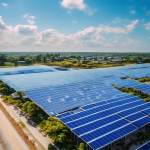
Some cold storage operators in Thailand are going further. If your facility is in an industrial estate with available land, ground-mounted solar can supplement or replace rooftop installations.
Case: Eastern Seaboard Cold Storage Park
A logistics company operating a 15,000 m² cold storage complex near Laem Chabang Port installed a hybrid system:
- Rooftop solar: 800 kWp on warehouse roofs (6,000 m² usable area)
- Ground-mounted solar: 400 kWp on adjacent vacant land (12,000 m² available)
- Total capacity: 1,200 kWp
- Annual generation: 1,800,000 kWh
- Annual savings: THB 9,000,000
- Payback: 4.5-5.0 years (lower ground-mount installation cost per kWp)
The ground-mount portion cost approximately THB 28,000-32,000 per kWp (cheaper than rooftop at THB 35,000-40,000 per kWp), making it attractive if land is available.
For cold storage parks in Thailand’s industrial estates — Amata City, WHA, Rojana, or Hemaraj — land is often available at reasonable lease rates, and the proximity to the facility means the generated power can be consumed directly without grid export complications.
Battery Storage for Cold Storage? The Honest Answer
We’ve written before about solar battery storage for Thai factories, and the question always comes up: “Should I add batteries to my cold storage solar system?”
The honest answer: probably not, unless you have specific backup power needs.
Cold storage facilities already have built-in thermal storage — the frozen product itself. A brief grid outage (30-60 minutes) won’t cause spoilage if the building is well-insulated. Most cold storage facilities in Thailand also have diesel backup generators that kick in automatically during outages.
Adding battery storage to a cold storage solar system adds THB 15,000-25,000 per kWh of storage capacity. For a 500 kWh battery system, that’s THB 7.5-12.5 million on top of the solar cost — doubling or tripling the total investment while adding relatively little value, since the refrigeration load can ride through short outages without batteries.
The exception: if you’re in an area with frequent, extended power outages (some rural PEA service areas experience 2-4 hour outages during storms), a smaller battery system (100-200 kWh) paired with solar could keep critical refrigeration loads running during outages, reducing diesel generator fuel costs. For most facilities in Thailand’s industrial estates, however, grid reliability is sufficient.
Regulatory Considerations for Cold Storage Solar in Thailand
Building Permits and Structural Assessment
Cold storage buildings in Thailand are typically steel-frame structures with insulated sandwich panel roofs. Adding 500 kWp of solar panels means mounting approximately 18-20 tonnes of additional weight on the roof (panels, racking, ballast).
A structural assessment by a licensed Thai engineer is mandatory. The roof must be rated for the additional dead load plus wind load (particularly important in coastal areas like Chonburi and Rayong, where typhoon-season winds can exceed 120 km/h).
If the roof structure isn’t sufficient, retrofitting typically costs THB 500,000-1,500,000 for a 500 kWp system. This is a one-time cost that should be factored into the project economics.
PEA/MEA Grid Connection
For a 500 kWp system, you’ll need to file a grid connection application with PEA (if outside Bangkok) or MEA (if in the Bangkok metropolitan area). The application process typically takes 4-8 weeks and requires:
- Single-line diagram of the solar system
- Inverter specifications (must meet PEA/MEA grid-tie standards)
- Structural assessment report
- Electrical contractor license
The good news: recent regulatory updates have streamlined the process for systems under 1 MWp, reducing approval times by approximately 50%.
Fire Safety for Cold Storage + Solar
Cold storage facilities present unique fire safety challenges. The insulation materials (typically polyurethane or polystyrene foam) are combustible, and DC wiring from solar panels adds an ignition source. Thailand’s Department of Disaster Prevention and Mitigation has issued specific guidelines for solar installations on cold storage buildings:
- DC rapid shutdown capability (within 30 seconds)
- Firefighter access pathways on the roof (minimum 1 m wide)
- Clear labeling of DC isolator locations
- Separation distance between solar arrays and ventilation/exhaust openings
Make sure your EPC contractor is familiar with these requirements. We’ve covered this in more detail in our regulatory guide for factory owners.
The Food Export Angle: Solar as a Competitive Advantage
Here’s something most cold storage operators in Thailand don’t think about: solar is a selling point for food exporters.
Thailand is one of the world’s largest food exporters — frozen seafood, processed chicken, tropical fruits, and rice. Major buyers in Europe, Japan, and North America increasingly require suppliers to demonstrate environmental responsibility. A cold storage facility powered by renewable energy can command a premium from ESG-conscious buyers.
Consider this scenario: a Thai frozen shrimp exporter needs cold storage services in the Eastern Seaboard. They’re choosing between two logistics providers with similar facilities, similar locations, and similar prices. One has rooftop solar (and can demonstrate 40% lower carbon footprint per ton of stored product). The other runs entirely on grid electricity.
Which one gets the contract?
For cold storage operators competing for international logistics contracts, solar isn’t just a cost-saving measure — it’s a competitive differentiator.
Common Mistakes Thai Cold Storage Operators Make with Solar
Mistake 1: Undersizing the System
Cold storage load profiles are flat and predictable. The risk of oversizing (producing more solar than you can consume) is minimal — in fact, most cold storage facilities could profitably install more solar than their roof area initially suggests. Don’t let an EPC talk you into a 300 kWp system when your roof can handle 500 kWp.
Mistake 2: Ignoring the South Side of the Roof
Some installers only panel the south-facing portion of a cold storage roof, thinking that east and west orientations produce too little. In Thailand’s tropical latitude (13-18°N), the difference between south-facing and east/west-facing generation is only 10-15%. For a large flat roof, using all available area — including east and west orientations — makes more financial sense than leaving half the roof empty.
Mistake 3: Choosing the Wrong Inverter Type
Cold storage facilities have high, continuous loads. String inverters are fine for small systems, but for 500 kWp+, central inverters or multiple commercial string inverters with proper load management are more efficient and easier to maintain.
Mistake 4: Not Planning for Future Expansion
Cold storage facilities often expand — adding new cold rooms, upgrading to lower temperatures, or adding value-added processing lines. If you’re installing solar now, size your inverter capacity and electrical infrastructure to accommodate 20-30% more panels in the future. The incremental cost of oversizing the inverter by 20% is small (THB 200,000-400,000) compared to the cost of replacing it later.
What to Ask Your Solar EPC Before Signing
When evaluating EPC contractors for your cold storage solar project, ask these specific questions:
- “Have you installed solar on a cold storage facility before?” — The thermal and structural dynamics are different from standard warehouses. Experience matters.
- “How will you handle the roof penetration?” — Cold storage roofs are insulated panels. Penetrations must be sealed to prevent thermal bridging and moisture ingress.
- “What’s your approach to DC cable routing through insulated panels?” — Improper routing can create fire hazards and void the roof warranty.
- “Can you integrate solar generation data with our building management system (BMS)?” — The ability to correlate solar output with refrigeration load is valuable for optimization.
- “What’s your warranty on roof waterproofing after installation?” — Cold storage roof leaks are expensive (product loss, insulation damage). Make sure the EPC guarantees the roof integrity.
For a more comprehensive guide on evaluating EPCs, see our article on choosing a solar EPC contractor in Thailand.
The Bottom Line
Cold storage facilities in Thailand are uniquely well-suited for rooftop solar. The combination of high daytime electricity consumption, large flat roofs, excellent solar irradiance, and rising grid electricity rates creates an investment case that’s hard to argue against.
A properly designed 500 kWp system for a mid-size cold storage facility in Thailand will:
- Generate 750,000 kWh of electricity per year
- Save THB 3.5-3.7 million annually on electricity costs
- Pay for itself in 5-5.5 years
- Deliver THB 70-75 million in cumulative savings over 25 years
- Reduce the facility’s carbon footprint by approximately 400 tonnes of CO₂ per year
And unlike many industrial solar applications, the self-consumption rate approaches 100%, meaning every kilowatt-hour of solar generation displaces the highest-cost grid electricity. There’s almost no wasted production.
The question isn’t whether cold storage solar in Thailand makes financial sense. It’s how quickly you can get it installed before your electricity bill climbs another 3% next year.